The Ripple Effect: What's Really Behind Gravel Driveway Potholes and Washboarding
September 14, 2026
Resurface or Regrade: How to Choose
| Factor | Resurface | Regrade |
|---|---|---|
| Scope | New layer on a sound base | Reshape slope and base |
| Best when | Surface worn, water still sheds | Water pools or damage repeats |
| Longevity | Short if grade is wrong | Years when paired with drainage |
| Risk | Hides a failing base | Minimal when done correctly |
| Return on effort | High only over solid ground | High when water is the problem |
Age, severity, and the soil under you should decide it. A young driveway with a firm base and one worn patch is a resurface. A driveway that floods, ruts, or fails in the same spot is telling you the grade is gone, and a surface fix will only mask it. Honest answer: sometimes a topcoat holds for years, and sometimes it covers a base that is already washing out. The tell is whether water leaves on its own. If it does, resurface. If it stands, regrade first.
QUICK ANSWER: Washboarding forms when tires cross loose gravel fast enough to bounce the surface into a series of ripples, worst where drivers brake, accelerate, or turn in the same spot every time. Potholes form a different way. Traffic grinds away the fine particles holding the larger stones together, and once those fines are gone, water works into the gaps and softens whatever sits underneath. Both problems trace back to the same short list of causes: not enough crown to shed water off the surface, a subgrade too soft or saturated to carry the load, gravel that lacks the right mix of stone and fines to lock together, and traffic that keeps hitting the same wheel tracks trip after trip. Once either pattern starts, it tends to feed itself — a shallow dip collects rainwater, the water softens the base a little more, and the next truck that crosses stretches the dip into something deeper.
You usually feel it before you see it. A driveway that used to feel solid starts sending a rhythmic shudder through the cab, a run of evenly spaced bumps that rattles loose tools in the truck bed and sloshes coffee out of the cup holder. A few weeks later, one of those low spots stops bouncing you and starts swallowing a tire instead. What looks like ordinary wear is really two separate failure patterns playing out in the same stretch of gravel, and each one leaves its own kind of fingerprint.
It matters which one is doing the damage. A driveway that's rippling but still firm underneath is telling a different story than one growing soft, wet craters. Both start with how the surface was built and how it gets used every day. Both get worse the longer the real cause goes unaddressed.
Where the Ripples Start: Traffic Patterns and Speed
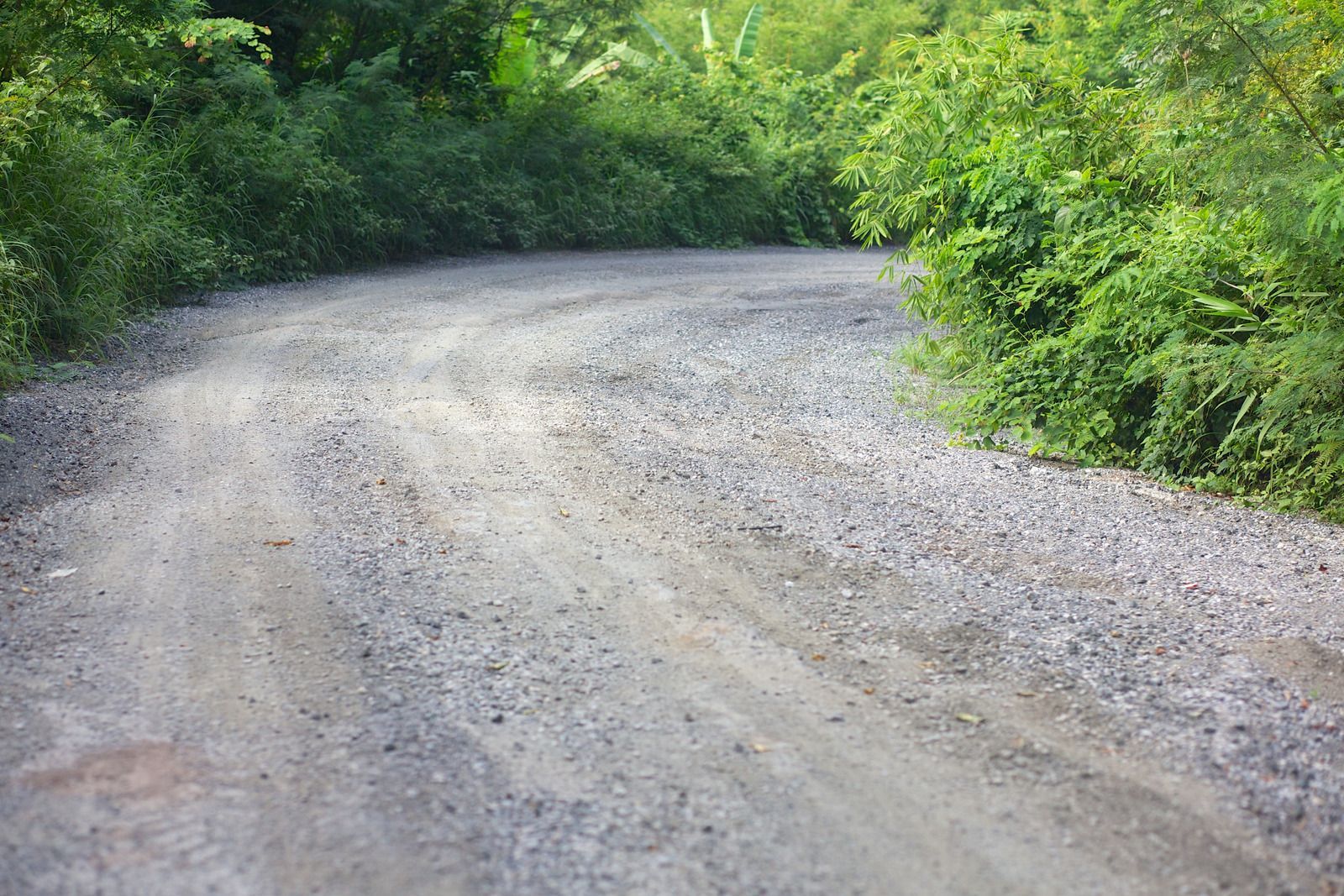
Washboarding, sometimes called corrugation, is a physics problem before it's ever a maintenance problem. Loose material on a driveway behaves a lot like sand on a beach — once something moves across it with enough force, the surface doesn't wear evenly, it organizes itself into ripples. A wheel rolling over gravel needs to reach a minimum speed before it bounces hard enough to reshape the surface, the same way a skipped stone needs enough speed to bounce off water instead of sinking. Below that threshold, tires just roll over small irregularities. Above it, every bump launches the tire slightly into the air, and it lands a little further along, digging a small trough. The next vehicle hits that trough, bounces at the same point, and digs it deeper. Give it a surprisingly short number of passes and the random bumps line up into a uniform pattern of ridges, spaced almost like clockwork.
Braking and accelerating zones take the worst of it. Any spot where drivers speed up, slow down, or turn — near a gate, at the top of a slope, coming up on a parking pad — sees more horizontal force hit the gravel than a straight, steady stretch does. That extra shear is what shoves loose material sideways and kicks off the corrugation pattern. Rural driveways see this constantly: a truck slowing for a cattle guard, a trailer easing into position by the barn, the same tires braking at the same bend every single day. The gravel underneath never gets a break.
Weight matters just as much as speed. A single pass from a loaded livestock trailer or a concrete truck puts far more downward force through a small contact patch than a passenger car ever will. Repeated heavy loads compact gravel unevenly, and any spot that's a touch softer than its neighbors — a buried root, a low patch in the base, a section that never quite compacted right during installation — becomes the starting point for a rut that every subsequent truck helps carve deeper.
How Moisture Cycling Works Against the Surface
Water pulls in two opposite directions depending on the season, and that's what makes it such a stubborn problem. During wet stretches, rain works down between the stones and cuts the friction that normally holds them in place. Once that friction drops, tires shove particles sideways more easily, and any water sitting in a low spot softens the base material directly beneath it. A soft base under load deforms. And a deformed base doesn't spring back once the water evaporates — it just sits lower than everything around it, waiting for the next rain to collect there too.
Dry stretches cause a different kind of trouble. A crust of fine material tends to form on a gravel surface, and for a while that crust actually helps hold everything together — right up until it dries out completely and turns brittle. Once tire pressure breaks that crust apart, the material underneath is looser than it was when the crust was intact. It's a big part of why washboarding often shows up worse coming out of a long dry spell: the protective layer that had been resisting movement is gone, and every pass grinds a little more material loose.
TIP: Pay attention to how the driveway behaves right after the first real rain following a dry spell. If ripples or soft spots show up faster than usual in that window, the surface crust has already broken down, and the gravel underneath needs attention before the next heavy rain makes it worse.
When the Crown Disappears: Drainage and Cross-Slope
A gravel driveway is supposed to carry a crown, a slight rise down the center or a steady cross-slope from one side to the other, so rain sheds off to the shoulders instead of sitting on the driving surface. Repeated grading pushes material toward the center over time. Traffic does the same thing. An installation that never had enough cross-slope to begin with runs into this problem even faster. However it happens, once that crown flattens out, water has nowhere to go but down into the wheel tracks. Standing water in a wheel path does two things at once — it softens whatever sits directly underneath, and it concentrates flow the next time rain falls, since water always follows the path the last rain already carved.
This is where washboarding and potholing start feeding each other. A washboard ripple creates a row of tiny basins that hold water instead of shedding it. Each basin softens the material below it a bit more with every rain event, until one of those basins breaks through from a shallow ripple into an actual pothole. Once that happens, the pothole becomes an even better water trap, and the whole cycle speeds up. A driveway that had a mild ripple problem for months can grow several deep potholes in a single wet season once the crown has flattened enough to let water pool instead of run off.
Drainage problems tend to show up fastest at transitions — where a driveway crosses a culvert, meets a road, or changes grade near a gate. Water naturally slows down at these points, and slowed water drops the sediment it's carrying, which clogs the pores that would otherwise let excess moisture drain through the gravel itself.
Fines Loss and Gravel Migration: Why the Surface Goes Loose
A gravel driveway surface isn't supposed to be a layer of uniform, marble-sized stones. A well-built surface course blends larger aggregate with finer material that fills the gaps between the bigger pieces and locks the whole mass together under compaction. That blend is what gives a gravel surface its firmness. Strip the fines out, and the larger stones have nothing holding them in place — they roll around underfoot like loose marbles instead of behaving like a bonded surface.
Traffic grinds those fines out slowly, pass by pass. Tires crush and abrade the smaller particles, and rain carries the loosened dust and sand toward the shoulders or into low spots off the traveled path. Over months and years, the surface course loses the material that was binding it together, leaving coarser, looser stone that migrates sideways under tire pressure. This migration drives both problems in this article. It feeds the ripple-forming mechanics behind washboarding, and it wears the surface thin unevenly, leaving some spots with barely enough depth to protect the base from wheel loads at all. Those thin spots are almost always where the first pothole opens up.
WARNING: Dumping loose gravel straight into a pothole without dealing with what's underneath is a short-term patch at best. The new material has nothing to compact against, hasn't been blended with binding fines, and typically washes or shifts right back out within a few rain events, especially if the spot keeps flooding because the surrounding crown is already gone.
How We Approach a Driveway Showing These Patterns
When we look at a driveway with active washboarding or potholes, we're not just looking at the surface. We're trying to pin down which of these mechanisms is actually driving the damage, since the right fix depends on the cause. A driveway with intact crown and a firm base but heavy corrugation near a gate is usually a traffic and fines problem, and it often responds well to reworking the surface course and rethinking where drivers brake and turn. A driveway with soft, water-holding potholes is telling a different story — one that usually points to a drainage or subgrade issue that surface gravel alone won't touch.
That's why our process starts below what you can see. We check whether the existing base still has enough structure to carry the load it's under, whether the cross-slope is still shedding water the way it should, and whether the surface material still carries the right blend of stone and fines for the kind of traffic the driveway actually sees — work trucks and trailers, not just passenger vehicles. Regrading without fixing a flattened crown or a saturated subgrade usually buys a few months at best, since the same ripples or dips tend to reappear in the same places once the underlying mechanics haven't changed. Fixing the crown, restoring real compaction, and rebuilding the surface course with the right material mix goes after the cause instead of just smoothing over the symptom for a season.
Frequently Asked Questions
What's the difference between washboarding and potholes?
Washboarding forms evenly spaced ripples as tires bounce over loose material near braking and turning zones. Potholes are depressions where lost fines let water soften the base underneath. Both share root causes, but form through different mechanics.
Why does washboarding come back in the same spots after grading?
If traffic pattern, speed, and braking points haven't changed, the same forces that created the ripples remain once traffic resumes. Grading smooths things temporarily but doesn't fix the fines mix or a flattened crown.
Does driving slower actually cut down on washboarding?
Yes, and it's one thing a property owner controls without construction. Washboarding needs a minimum bounce speed to shift material with each pass. Slowing through curves, gates, and parking areas cuts that force noticeably.
Can a fresh layer of gravel on top fix potholes for good?
It depends on what's underneath. A sound base with proper crown holds new material well. A saturated or poorly compacted base fights the same conditions that caused the pothole, so gravel migrates or washes out again.
Why do potholes seem to get bigger every time it rains?
A pothole already sits low, so it collects extra water each rain event. That moisture softens the exposed base, and passing traffic compresses it further, pushing the depression deeper without a drainage fix in place.
Does the type of gravel affect how fast these problems show up?
Yes, notably. Angular stone blended with enough fines interlocks under compaction, resisting both shifting and fines loss. Rounded, uniform material lacks that internal friction, so it migrates faster and shortens maintenance cycles.
Fixing the Cause Beats Smoothing the Symptom
Washboarding and potholes look like separate problems, but they both trace back to the same handful of weaknesses: a flattened crown, a soft or saturated subgrade, gravel that's lost its binding fines, or traffic hitting the same wheel tracks day after day. Regrading buys time by smoothing the surface, but if the underlying mechanics haven't changed, the same ripples and dips tend to reappear in the same places once traffic resumes.
Huber Earthworks
has spent 8+ years working on driveways across Thorndale, TX, tracing these patterns back to their actual source before recommending a fix. A driveway with intact crown and a firm base needs a different approach than one with soft, water-holding craters, and telling the two apart is what separates a repair that lasts through the next wet season from one that just buys a few months.